
WELCOME BONUS 300%
UP TO €2000 + 100
FREE SPINS
UP TO €2000 + 100
FREE SPINS
Home → Games
Casino games at Spinanga Casino
Multihand Blackjack with Up to 5 Hands
Blackjack 6 Decks, S17, DAS, DOA, Auszahlung 3:2, Basisstrategie offers a house edge of 0.46% when the player adheres to strict basic strategy rules. This mathematical advantage is significantly lower than the 0.95% typically found in single-deck games without favorable doubling rules. The dealer stands on soft 17, which reduces the casino's inherent probability of winning compared to hitting soft 17 scenarios. Consequently, the expected return remains stable at 99.54% over extended play sessions for disciplined participants.
The capability to play up to five hands simultaneously increases the hourly decision count, thereby amplifying the total amount wagered per hour. While the house edge stays constant at 0.46%, the variance rises because more bets are resolved in each round. A standard deviation of 1.00 for similar table games suggests that bankroll management must account for these faster outcomes. Players should calculate their session budget based on this increased velocity to avoid premature depletion of funds during losing streaks.
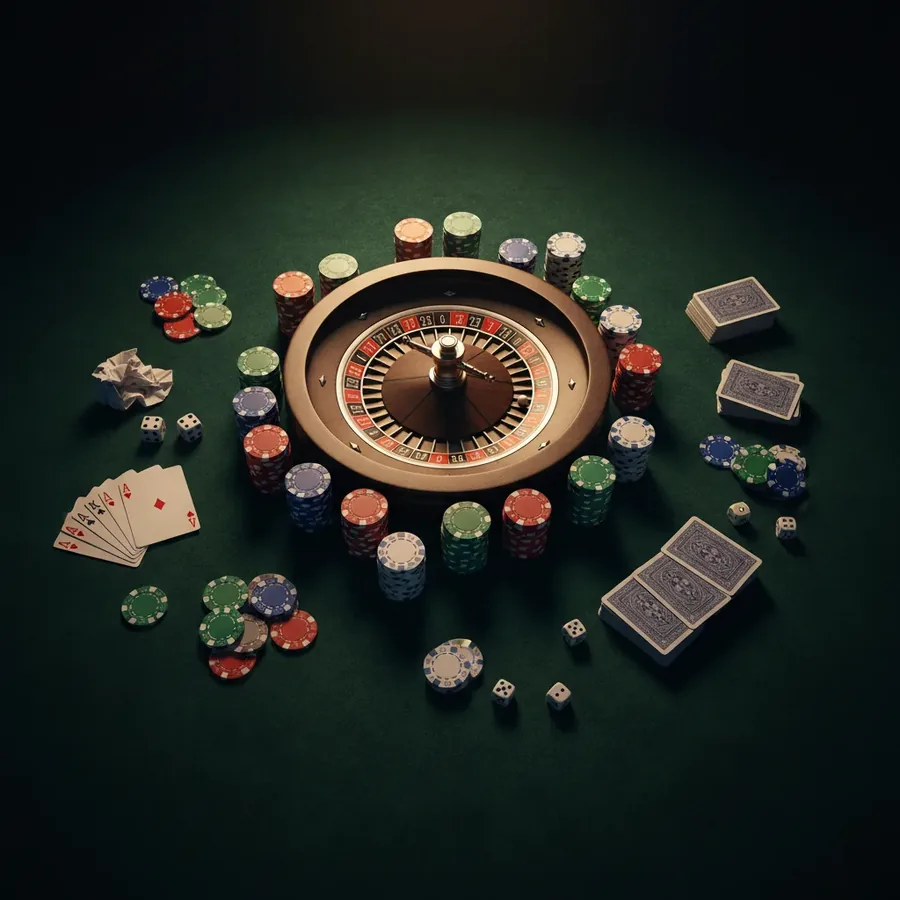
Roulette Wheel with 37 vs 38 Pockets
American Roulette features a wheel with 38 pockets, including both 0 and 00, which creates a higher house edge for most wagers compared to European variants. The Five Number Bet covering 0, 00, 1, 2, and 3 carries a steep house edge of 7.89%, making it the worst option on the table. In contrast, French Roulette utilizes a 37-pocket wheel where the La Partage rule applies to even-money bets like Red or Black. This rule refunds half the stake when the ball lands on zero, effectively halving the house edge to 1.35%. Therefore, the pocket count directly influences the long-term profitability for the player seeking consistent returns.
Split 17:1 and Corner 8:1 in Payout Comparison
Inside bets on roulette wheels offer fixed payouts regardless of the number of zeros present on the physical wheel layout. A Split bet pays 17:1, covering two adjacent numbers, while a Corner bet pays 8:1, covering four numbers in a square formation. These payout ratios remain identical across American, European, and French roulette versions, despite the differing house edges caused by the zero slots. Understanding these static payouts helps players distinguish between bet value and actual expected loss over time. The mathematical expectation changes due to the probability of winning, not the prize multiplier itself.
Submit documents no older than three months
KYC verification requires players to submit identity documents that are no older than three months to ensure current validity and security compliance. This time limit prevents the use of outdated credentials that may no longer accurately reflect the user's personal situation or legal status. Financial regulations mandate this recency to mitigate risks associated with fraud and money laundering activities within the gaming platform. Accounts failing to provide valid documentation within this window may face restrictions on withdrawals or account access. The three-month rule applies strictly to all submitted proof of address and identification papers.
Game Shows: sectors, multipliers, and bet ranges
Sic Bo Special Bets involve distinct sectors on the dice tray with varying multipliers that determine the potential return on investment. Specific Triple bets pay 180:1 but carry a high house edge of 16.20%, whereas Single Number bets offer lower multipliers like 3:1 with a much better edge of 7.87%. These wide variations in payout structures require players to understand the specific risk-reward profile of each sector before placing wagers. The volatility differs significantly between betting on any triple versus specific doubles, impacting bankroll longevity. Careful selection of bet types can optimize the theoretical return within the game's constraints.
Game categories at a glance
| Category | Examples | Stakes From | Highlight |
|---|---|---|---|
| Slots | Book of Demi Gods 2, Jammin' Jars, Money Train 3 | 0,10 EUR | thousands of titles |
| Table games | Roulette, Blackjack, Baccarat | 0,50 EUR | classic rules |
| Live casino | Blackjack Party, Ultimate Texas Hold'em | 0,20 EUR | real dealers |
| Jackpot games | Mega Moolah, Divine Fortune, Age of the Gods | 0,20 EUR | progressive pools |
| Instant games | Aviator, Plinko, Mines | 0,10 EUR | fast rounds |
| Video poker | Jacks or Better, Deuces Wild | 0,25 EUR | strategy based |
9/6 table: nine for Full House, six for Flush
The designation "9/6" in Video Poker Jacks or Better refers to the payout coefficients for two specific hands. A Full House returns 9 units per coin wagered, while a Flush pays 6 units per coin. This specific combination is required to achieve the game's advertised theoretical return.
These payouts are significantly higher than lower-tier tables, such as those paying 8 for a Full House and 5 for a Flush. The increased coefficients directly reduce the mathematical disadvantage for the player over the long run. Without this specific paytable structure, the return on investment drops below acceptable levels.
This configuration enables an RTP of 99.54% when optimal strategy is applied correctly. Players must bet five coins to unlock the Royal Flush bonus of 4000 units instead of the standard 800. Missing the max bet requirement drastically reduces the effective yield despite the favorable table rules.
Video Poker 9/6: What the Two Numbers Mean
The first number in the 9/6 designation indicates that a Full House pays 9 times the single-coin wager. The second number signifies that a Flush pays 6 times the stake. These two values define the variance profile of the Jacks or Better variant.
Comparing this to Deuces Wild Full Pay reveals different structural priorities, where Five of a Kind pays 15 units. In Jacks or Better, the Straight Flush pays only 50 units, whereas the Full House and Flush carry heavier weight. This distribution favors consistent small-to-medium wins over rare mega-payouts.
Adhering to the optimal strategy for these specific payouts yields a house edge of just 0.46%. Any deviation from the correct play increases the casino's advantage immediately. The standard deviation of 4.42 indicates moderate volatility typical for this pay structure.
Three Roulette Variants, Three House Edges Compared
American Roulette features a double zero pocket that creates a distinct disadvantage for players on specific bets. The Five Number Bet covering 0, 00, 1, 2, and 3 carries a house edge of 7.89%. This is the worst wager available on any roulette wheel due to its unique coverage of five sectors.
European Roulette eliminates the double zero, reducing the base house edge to 2.70% on inside bets. French Roulette further improves odds by introducing La Partage for even-money wagers like Red or Black. This rule refunds half the stake if the ball lands on zero, lowering the edge to 1.35%.
The American wheel lacks any equivalent to the La Partage rule, keeping edges high on all outside bets. While French and European wheels share the same physical layout, the additional rule makes French superior for even-chance players. Inside bets in French roulette revert to the standard 2.70% edge since La Partage does not apply there.
Before sitting down: check table bet limits
Table games contribute only 10% toward the wagering requirements of the 300% welcome bonus up to €2,000. Slots count for 100%, making them mathematically more efficient for clearing the bonus funds. Players utilizing the bonus on live dealer tables must wager ten times more volume than slot players.
Live dealer games often impose minimum and maximum bet limits that constrain bankroll management strategies. High-limit tables may allow larger stakes but still fall under the restrictive 10% contribution rate. Understanding these caps is essential before deploying bonus funds on blackjack or baccarat variants.
The 10% contribution applies regardless of whether the player chooses standard RNG or live streamed tables. This uniform restriction forces players to generate substantial turnover to convert bonus credits into withdrawable cash. Ignoring this term can lead to rapid depletion of funds without meeting clearance conditions.
Double Down: Doubling Your Bet After Two Cards
Blackjack with six decks, S17, DAS, and DOA allows doubling down on any two-card total. DAS permits doubling after splitting pairs, which significantly expands strategic opportunities for the player. This rule set supports the low 0.46% house edge when combined with basic strategy.
Doubling down increases the initial wager by 100% in exchange for receiving exactly one additional card. This aggressive move is optimal when the player holds a strong total against a weak dealer upcard. The ability to double on split hands maximizes profit potential during favorable streaks.
Insurance pays 2:1 but carries a much higher house edge and should generally be avoided by basic strategy users. The primary focus remains on maximizing expected value through correct doubling decisions rather than side bets. Correct application of these rules ensures the theoretical RTP of 99.54% is maintained.
American Roulette: 5.26 Percent Due to Double Zero
The American Roulette Five Number Bet covers the sectors 0, 00, 1, 2, and 3 with a payout of 6:1. This specific wager is an exception on the wheel because it carries a house edge of 7.89 percent, which exceeds the standard 5.26 percent rate found on all other bets at this table. Players lose value faster here than anywhere else on the layout, making it a trap for casual wagers.
This single bet includes two green zero pockets out of 38 total sectors, creating the inflated risk profile. By contrast, the Straight bet on a single number pays 35:1 but retains the baseline 5.26 percent house advantage. The disparity highlights how the inclusion of the double zero disproportionately impacts small-area coverage bets compared to full-number selections.
A player betting 10 euros on this line risks a theoretical loss of 0.79 euros per spin over the long term. This rate applies exclusively to this combination; all other outside or inside bets maintain the lower 5.26 percent edge. The discrepancy remains constant regardless of stake size due to the fixed mathematical structure of the wheel.
Dozen 2:1: Twelve Numbers, One Third Coverage
The Dozen bet in French Roulette offers a payout of 2:1 for covering twelve numbers on the layout. This selection represents exactly one third of the non-zero pockets on the wheel, providing balanced exposure without the volatility of single numbers. The risk-reward ratio remains consistent across all three dozen sections available to the player.
When playing European rules where La Partage does not apply to inside or dozen bets, the house edge sits at 2.70 percent. This figure is identical to the Straight bet despite the vastly different coverage area and payout structure. The mathematical expectation remains stable because the probability of hitting twelve numbers aligns precisely with the 2:1 return.
Wagering 30 euros on a dozen yields a potential profit of 60 euros upon success, offsetting the initial stake. Over thousands of spins, the casino retains 0.81 euros from every 30 euro unit placed on this market. The consistency allows players to manage bankroll duration more effectively than high-variance straight-up wagers.
Some variants offer La Partage for even-money bets, but this protection never extends to dozen placements. Consequently, the entire stake is lost if the ball lands on zero, maintaining the standard 2.70 percent disadvantage. Players must accept this full forfeiture risk when selecting this coverage type.
House Edge and RTP: Two Names for the Same Number
The House Edge represents the average percentage of each wager that the casino retains over the long run. For Baccarat Banker bets, this margin stands at 1.06 percent after accounting for the standard 5 percent commission on wins. This fee reduces the effective payout from 1:1 to 0.95:1, balancing the statistical advantage gained by the banker position.
Return to Player (RTP) expresses the same mathematical reality from the opposite perspective, indicating the portion returned to participants. An RTP of 98.94 percent corresponds directly to the 1.06 percent house edge in Baccarat Banker outcomes. These metrics are interchangeable values describing the same underlying game mathematics.
A player investing 1,000 euros into Baccarat Banker hands can expect a theoretical return of 989.40 euros. This calculation assumes infinite play volume and perfect adherence to the standard commission structure. Short-term results will fluctuate wildly around this mean due to the inherent variance of card dealing.
Side bets like Baccarat Pair operate with significantly higher edges, such as 10.36 percent for Player Pair outcomes. This divergence proves that the main game and auxiliary wagers utilize entirely separate mathematical models. Selecting the primary bet ensures the lowest possible house advantage available in the room.
Hold or discard five cards: the decision
Video Poker Deuces Wild Full Pay tables feature a unique mechanic where all four deuces act as wild cards. This rule enables the formation of Five of a Kind, which pays 15 coins and contributes to an exceptional 100.76 percent RTP. Such a positive expected value exists only when players execute optimal strategy with maximum coin bets.
Discarding five cards requires evaluating whether retaining deuces improves the hand potential more than keeping natural combinations. Keeping all wild cards maximizes the chance for high-paying hands like Four Deuces or Natural Royals. Deviating from this heuristic typically drops the RTP below 100 percent rapidly.
The Natural Royal Flush pays 800 coins, while the Four Deuces hand rewards 200 coins for utilizing all jokers. These payouts define the upper limit of profitability on this specific machine configuration. Players must master these priorities to maintain the theoretical edge provided by the game design.
Standard deviations in this game reach extreme levels due to the rarity of five-of-a-kind combinations. A single session may yield massive swings that obscure the long-term mathematical advantage. Discipline in holding wild cards remains the only method to realize the advertised returns.
When to Surrender 16 vs 10?
Blackjack surrender options allow players to forfeit half their bet when facing a dealer ten upcard with a hard sixteen. This maneuver reduces the house edge in six-deck games offering surrender down to 0.46 percent from the baseline. The decision hinges on the statistical probability of busting versus losing to a strong dealer hand.
The standard rule set includes Standing on Soft 17, Double After Split, and Double on Any two cards alongside surrender rights. These favorable conditions collectively push the house edge to its minimum of 0.46 percent for the player. Utilizing basic strategy correctly ensures this low disadvantage rate is maintained throughout the session.
A player surrendering a sixteen against a ten loses fifty percent of the original stake immediately. While this guarantees a partial loss, it prevents the near-certain full loss that occurs when hitting or standing. The math favors preserving capital over attempting to improve a weak hand against a strong dealer.
Insurance bets pay 2:1 but carry a significantly higher house edge and should never be taken. This side option distracts from the core strategic decisions regarding hitting, standing, or surrendering. Focusing solely on base game strategy preserves the 0.46 percent advantage defined by the ruleset.
Contact
Live - online chat
Banking


Providers








Spinanga Casino 2026